Husband Frank Russell, 2nd Earl Russell
Queer Places:
Schloss Nassenheide, Rzędziny, 72-003 Poland
St Margaret Churchyard, Hammersley Ln, Loudwater, Penn, High Wycombe HP10 8EG, United Kingdom
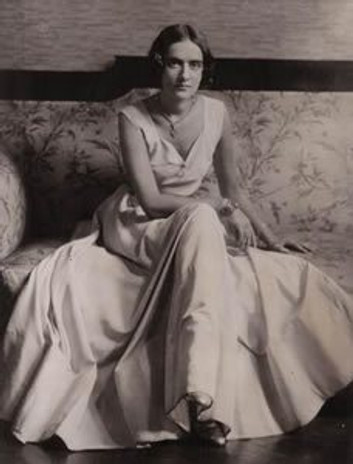 Elizabeth von Arnim (August 31, 1866 - February 9, 1941), born Mary Annette Beauchamp on August 31, 1866, at Kirribilli Point in Sydney, Australia, was a
celebrated novelist of multiple nationalities whose sharp, Austen-like wit concealed subtle critiques of Victorian and Edwardian social mores beneath
ostensibly domestic and feminine themes. The daughter of wealthy shipping merchant Henry Herron Beauchamp and Elizabeth Weiss Lassetter, she was known to
her family as May and grew up alongside four brothers and a sister. When she was three years old, her family relocated to England, subsequently spending
several formative years living in London and Switzerland. Among her notable literary relatives was her first cousin once removed, the acclaimed New
Zealand-born writer Katherine Mansfield, with whom Elizabeth later corresponded and spent considerable
time during Mansfield's stay in Switzerland in the early 1920s. Educated at the Royal College of Music where she specialized in the organ, Elizabeth
cultivated a sophisticated artistic sensibility that would deeply inform her writing career.
Elizabeth von Arnim (August 31, 1866 - February 9, 1941), born Mary Annette Beauchamp on August 31, 1866, at Kirribilli Point in Sydney, Australia, was a
celebrated novelist of multiple nationalities whose sharp, Austen-like wit concealed subtle critiques of Victorian and Edwardian social mores beneath
ostensibly domestic and feminine themes. The daughter of wealthy shipping merchant Henry Herron Beauchamp and Elizabeth Weiss Lassetter, she was known to
her family as May and grew up alongside four brothers and a sister. When she was three years old, her family relocated to England, subsequently spending
several formative years living in London and Switzerland. Among her notable literary relatives was her first cousin once removed, the acclaimed New
Zealand-born writer Katherine Mansfield, with whom Elizabeth later corresponded and spent considerable
time during Mansfield's stay in Switzerland in the early 1920s. Educated at the Royal College of Music where she specialized in the organ, Elizabeth
cultivated a sophisticated artistic sensibility that would deeply inform her writing career.
Her personal life was defined by international moves, aristocratic marriages, and literary romances. On February 21, 1891, she married Count Henning
August von Arnim-Schlagenthin, a widowed German aristocrat whom she had met while touring Italy with her father. The couple initially lived in Berlin
before moving in 1896 to Nassenheide, their landed estate in Pomerania, where they had four daughters and a son. During their time at Nassenheide, the
children's tutors famously included literary figures such as E.M. Forster and
Hugh Walpole. Following financial difficulties and the sale of the estate, the family moved to London in 1908.
After her first husband's death in 1910, Elizabeth built the Chalet Soleil in Randogne, Switzerland, and engaged in a three-year affair with novelist
H. G. Wells. In January 1916, she entered into a second marriage with
Frank Russell, 2nd Earl Russell, the elder brother of philosopher
Bertrand Russell. This union proved intensely acrimonious, leading to a permanent separation in 1919 though
they never formally divorced. Later in life, she maintained homes in Switzerland and the south of France, where she cultivated a magnificent rose garden
at her property, Mas des Roses, in Mougins. Fleeing the outbreak of the Second World War, she moved to the United States in 1939 and ultimately passed
away from influenza at the Riverside Infirmary in Charleston, South Carolina, on February 9, 1941. In accordance with her wishes, her ashes were returned
to England in 1947 and interred at St Margaret's churchyard in Tylers Green, Buckinghamshire, beneath a headstone bearing the Latin inscription parva sed
apta (small but apt).
Elizabeth launched her literary career anonymously with the sensational semi-autobiographical satire Elizabeth and Her German Garden in 1898, which
chronicled her struggles with gardening and integration into German Junker society while famously caricaturing her first husband as "The Man of Wrath."
Following this immense commercial success, she published more than twenty books simply as "Elizabeth" or under alternative pseudonyms like Alice
Cholmondeley. Her bibliography encompasses celebrated works such as The Solitary Summer, The Benefactress, Vera—a dark tragicomedy mirroring her
disastrous marriage to Lord Russell—and The Enchanted April, an ebullient masterpiece inspired by an Italian holiday that permanently popularized the
coastal resort of Portofino. Many of her works received major cinematic adaptations, including The Enchanted April and her final novel, Mr. Skeffington,
which was adapted into an Academy Award-nominated film starring Bette Davis.
Elizabeth von Arnim's dual British and German allegiance, combined with her cosmopolitan literary circle spanning Switzerland, France, and England,
positioned her within sophisticated European artistic networks that intersected with notable queer figures and writers of her era. Through her close
friendships and literary associations—such as her mutual intellectual circles with prominent author and critic
Vernon Lee (Violet Paget), a central figure in aestheticism and lesbian literary history, and their mutual friend
Irene Forbes-Mosse—Elizabeth operated as an effective cultural messenger across national divides during
and after the Great War. Furthermore, her intimate literary friendships with women writers of independent means and avant-garde sensibilities, her
exploration of female autonomy, and her critiques of traditional patriarchal marriage structures in works like Vera and Love have led modern feminist
critics, particularly publishers like Virago Press since the 1980s, to reassess her legacy as a vital voice aligning with early feminist and progressive
literary traditions.
References:
- Leslie de Charms, Elizabeth of the German Garden: A Biography (London: Heinemann, 1958) — the first published biography of Elizabeth von Arnim (written under the pseudonym Liebet).
- Karen Usborne, "Elizabeth": The Author of Elizabeth and Her German Garden (London: Bodley Head, 1986).
- Kirsten Jüngling and Brigitte Roßbeck, Elizabeth von Arnim; Eine Biographie (Frankfurt: Insel, 1996).
- Joyce Morgan, The Countess from Kirribilli (Sydney: Allen & Unwin, 2021).
- Isobel Maddison, Elizabeth von Arnim: Beyond the German Garden (Farnham: Ashgate, 2013) — featuring discussions on her relationship with Katherine Mansfield and her literary contexts.
- Juliane Römhild, Femininity and Authorship in the Novels of Elizabeth von Arnim (New Jersey: Fairleigh Dickinson University Press, 2014).
- Jennifer Shepherd and Noreen O'Connor (eds.), New Readings of Elizabeth von Arnim: The Unexpected Modernist (Edinburgh: Edinburgh University Press, 2025).
- Katherine Ayer, "Elizabeth von Arnim (Countess Mary Annette Beauchamp Russell)", Dictionary of Literary Biography, Late-Victorian and Edwardian British Novelists: Second Series, Vol. 197 (Gale Research, 1999).
- The Elizabeth von Arnim Society (elizabethvonarnimsociety.org) — an ongoing scholarly resource providing comprehensive primary bibliographies, correspondence records with literary figures like Vernon Lee, Henry James, and Virginia Woolf, and biographical documentation.
Support this project
This website is a passion project researched, developed, and funded entirely by me. If you find the content valuable and would like to help support the ongoing research and hosting costs, any contribution is deeply appreciated.
Thank you for keeping this independent resource alive!
My books on Amazon: Elisa Rolle's books
BACK TO HOME PAGE